
What Problem Is DevOps In The Cloud Actually Solving For You?
Cloud migrations usually begin with simple promises—lower costs, better uptime, easy scaling—but quickly spiral into complexity as environments, services, regions, and teams multiply, making every change feel dangerous and every release slow. This is exactly where cloud-native DevOps becomes critical, driving faster and safer delivery through automation, repeatable pipelines, and shared visibility across engineering and business teams. Instead of treating the cloud like a remote data center, DevOps turns it into a governed platform with guardrails and feedback loops that make continuous change normal. With a partner like ALGO CAS, organizations can pair AWS-native tooling with mature delivery practices to gain both speed and control from day one.
You do not have to be a global tech giant to benefit from DevOps. What you need is pain that is clear enough, and a small group willing to change how they work.
What Problem Is DevOps In The Cloud Actually Solving For You?
Continuous Integration And Delivery
Aim for a single automated pipeline per application that:
- Builds and tests your code on every change
- Bakes an immutable artifact (image or package)
- Can deploy to a test environment with one click
Once this is in place, you can experiment safely. Blue green or canary strategies become much easier in the cloud, where you can spin up extra capacity on demand.
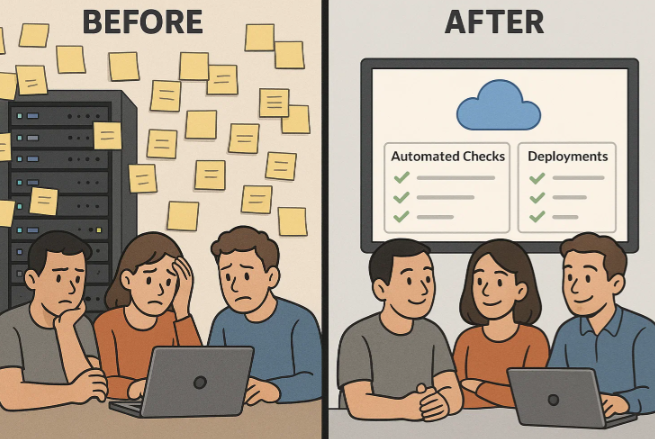
Infrastructure As Code
Manually clicking around the console works in the early days. It does not scale.
Templates using tools like AWS CloudFormation or Terraform let you:
- Recreate environments consistently
- Track infrastructure changes in version control
- Review and approve changes like you review code
This is one of the fastest ways to remove “works on my environment” arguments.
Observability From Day One
If you automate delivery but cannot see what is happening, you have only moved the risk somewhere else.
Start with:
- Central logs
- Key metrics per service
- Simple, meaningful alerts
Later you can add traces and dashboards for deeper analysis.
Where Does DevOps Help Most In Your Cloud Journey?
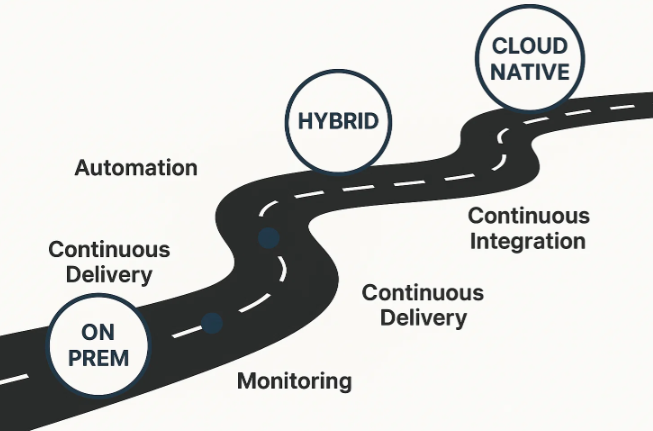
Different organizations are in different stages. DevOps looks slightly different at each phase, but the principles stay the same.
An experienced partner can help you identify your current stage and design DevOps practices that fit, instead of forcing a one size template onto your teams. algocas.com
How Do You Design A Scalable DevOps Pipeline In AWS?
A good pipeline should feel boring in the best possible way. Clear steps, predictable behavior, no surprises.
A simple but scalable pattern might look like this:
Code And Branching
Keep a clean main branch. Use feature branches and pull requests, with automated checks running on each change.
Build And Test Stage
Run unit and integration tests in a standardized build environment. Produce a single artifact such as a container image tagged with version and commit id.
Security And Quality Gates
Add static analysis, dependency scans, and basic policy checks. In the cloud this often integrates directly with your artifact registry and source control.
Deploy To Non Production
Use infrastructure as code templates to create and update environments. Every deployment runs the same scripts, not custom commands.
Progressive Delivery To Production
Start with simple strategies like rolling updates. As traffic grows, consider canary or blue green to reduce risk.
Feedback Loop
Each deployment should trigger monitoring updates and alerts. If something breaks, the pipeline should make it easy to roll back or roll forward.
How Can Automation Keep Your Cloud Costs Under Control?
What Does A Practical Cloud DevOps Roadmap Look Like?
A roadmap does not need fifty steps. It needs a clear sequence your teams can follow.
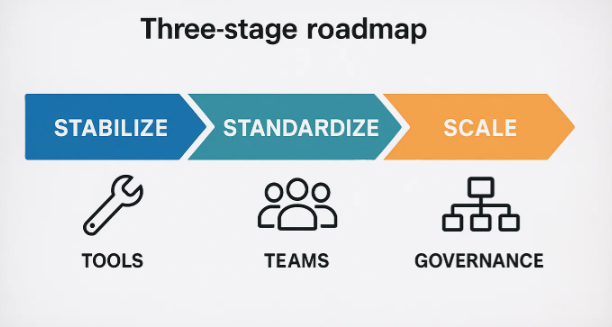
Here is a simple three stage view.
Stage 1: Stabilize
Goal: reduce risk and firefighting.
- Map current deployments and environments
- Centralize logging and basic monitoring
- Create a manual but documented release path to production
At this point you already remove chaos and give teams a single source of truth.
Stage 2: Standardize
Goal: remove manual differences between services.
- Introduce a common CI template for all applications
- Move core infrastructure to templates
- Add basic security and quality gates in the pipeline
Now teams start to share patterns instead of inventing their own for every project.
Stage 3: Scale
Goal: support more teams and more apps without losing control.
- Add progressive delivery patterns and self service environments
- Build a small platform team to own shared tooling and guardrails
- Integrate cost controls and advanced observability
At this stage DevOps is no longer a project. It is how your organization builds and runs software.

How Can A Partner Like ALGO CAS Help You Move Faster With Less Risk?
Most teams know they need better DevOps in the cloud. The challenge is time and expertise.
A partner focused on tailored cloud solutions, with deep AWS experience, can help you skip months of trial and error.
Typical ways a partner like ALGO CAS can support you:
- Assess your current cloud and delivery setup
- Design a practical DevOps roadmap aligned with your business goals
- Implement CI pipelines, infrastructure as code, and observability foundations
- Train your teams so they can own and evolve the platform
You bring deep knowledge of your business and applications. The partner brings patterns that already work, plus battle tested cloud practices.
Over time the goal is not to depend on external help for every change. The goal is to build an internal culture where DevOps and cloud go together naturally, and where automation is simply how work gets done.